CAMPAIGN REVIEW:TUSKER LITE MT.RWENZORI MARATHON 2026
- 7:03 am
Just before sunrise on August 22, 2026, a crowd gathered at the Equator monument inside Queen Elizabeth National Park, waiting on a starting gun.
It wasn’t an ordinary wait. For the first time, the runners assembled at that exact line on the map weren’t simply racing toward Kasese, many were racing toward an official qualifying mark.
The Tusker Lite Mt Rwenzori Marathon had, in its fifth year, achieved World Athletics Label Road Race status, becoming the first Ugandan marathon and only the third in East Africa to reach that tier.
A field that opened in 2022 with roughly 800 entrants had swelled, five editions later, to somewhere around 8,000.
This review traces how the fifth edition’s marketing effort was built, what it achieved, and where the next edition has room to grow stronger.
The big idea.
The organizing thought behind the campaign was simple: an anniversary reframed as proof of arrival. Rather than treat the fifth edition as just another lap, the messaging consistently positioned the marathon as something that had outgrown its origins as a beverage brand’s sponsorship activation and matured into a recognized piece of the country’s sports-tourism identity.
That framing showed up consistently across spokespeople. Elizabeth Mutamuliza, the head of beer at UBL, spoke to the five-year arc as evidence that an initial ambition, to build a shared experience around fitness, adventure and community, not merely a footrace, had actually taken hold.
Brand Manager Sandra Againe extended the same logic into a tourism argument, describing the race as a growing driver of visitor spending across Kasese’s hotels, restaurants and transport businesses. Holding one coherent narrative together across a milestone year, with this many voices speaking to press, is not a small achievement.
Execution.
The execution centered on one high-visibility set-piece, backed by a longer stretch of community and operational groundwork.
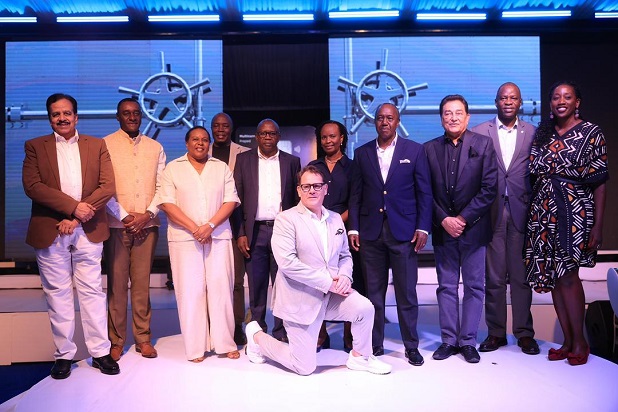
The standout moment was the kit unveiling on August 6, staged at Uganda Breweries’ Luzira headquarters. Rather than a standard press briefing, the event was staged as a runway show, with models and competing athletes both showcasing the anniversary jersey on a runway.
Award winning PR agency- Pivot Media and Marketing, produced and ran that reveal, turning what might otherwise have been a routine product announcement into the campaign’s strongest earned-media moment. The jersey itself, designed by MAAD McCann. together with Maren Hald Bjørgum and the internal Tusker Lite team, carried its own layer of storytelling. Its contour-line pattern traces the climb runners face between the 28- and 35-kilometre marks near Kilembe, a rising-sun graphic nods to the race’s Equator start, and a small anniversary mark honors the milestone.
It’s a thoughtful detail, the kind that lands specifically with someone who has actually felt that hill underfoot.
Roughly a month earlier, on July 19, a community activation run gave Kasese residents a preview of the course over 5-kilometre and 10-kilometre distances. Marathon CEO Collins Masiga used the moment to underline the event’s intent to engage the host town directly rather than simply pass through it, with government security representatives joining to reassure participants the race would be well managed.
Operationally, the campaign ran across two cities: kit collection and expo activity in Kampala- from August 14 to 16, followed by race-week collection in Kasese- from August 19 to 21, ahead of the event.
On the technical side, World Athletics-certified course measurer Gavin Wright re-verified the route, alongside a broader review of hydration points, marshal positioning and road-closure planning ,the less visible work that actually underpins a Label designation. Uganda Red Cross served as the event’s official health partner, staffing ambulances and first-aid points along the course.
The race itself produced a genuinely elite result worth building a story around: Ugandan Leonard Chemonges took the men’s marathon title, and Kenya’s Margaret Jepchumba won the women’s race, giving the fifth edition a credible competitive angle to sit alongside its tourism messaging.
Integration across channels.
The campaign’s clearest strength was message discipline. The same handful of themes, the five-year milestone, Label status, tourism impact, community involvement carried consistently across press events, government and diplomatic engagement, and sponsor communications. Uganda’s Consulate in Arusha publicly endorsed the race as a way to draw interest from the Tanzanian market, and Uganda Development Bank’s Shs 20 million sponsorship, announced by Managing Director Patricia Ojangole, was framed explicitly around tourism’s economic value, a sign the core narrative had moved beyond the marathon’s own team and taken hold with outside validators.
Owned channels; Instagram and X carried the expected countdown content, kit teasers, registration prompts and behind-the-scenes design detail, while outlets such as Pulse Uganda, Kawowo Sports and the Ministry of Tourism’s own platform picked up the anniversary and Label-status story closely, an indication that the press materials and the runway moment had done their intended work.
Where there’s room to build further is the space between those larger media moments.
The campaign had one clear hero event, the kit runway and one grassroots event, the community run. Outside of those two windows, the owned social presence (Instagram sits under 5,000 followers for a race that now holds international certification) currently functions more as a channel for scheduled announcements than as a year-round community.
Return on Investment.
Judged against what’s publicly visible, the return on this campaign looks solid. A field that has grown roughly tenfold across five editions, from about 800 to an estimated 8,000, is the single most compelling number in the entire campaign, and it clearly helped secure sponsor commitment: Uganda Development Bank’s renewed backing, along with KIA, Britam Insurance, Rwenzori Natural Mineral Water, UCC, and the Ministry of Tourism, Wildlife and Antiquities, all feature as partners on the 2026 kit, alongside travel-trade endorsement from operators like Great Lakes Safaris, who now package the race into standing tourism itineraries.
The tourism-spend claim is the one area where confidence currently outpaces evidence. It’s a plausible and probably accurate story, but as things stand, there’s no published occupancy data, visitor-spend estimate, or economic-impact figure attached to it. Worth flagging for a brand that will likely lean on this argument again when courting future sponsors.
A few areas worth watching.
The fifth edition met its core brief: reinforcing the marathon’s standing and its tourism narrative and the fundamentals here are sound. A handful of refinements would make the next edition stronger still.
The event’s digital footprint hasn’t quite scaled with its on-ground growth. A race that has grown tenfold and just earned international certification could reasonably support a larger, more continuously engaged-owned audience than it currently holds.
The “international” dimension of the story is, for now, more potential than demonstrated. Label status is a genuinely valuable credential, it opens a path for Ugandan athletes to use Rwenzori times to qualify for races like Comrades, Two Oceans, and the World Marathon Majors, but the campaign hasn’t yet shown that pathway playing out through a named runner or a recruitment story.
The tourism impact narrative would land more firmly paired with even modest published figures. It reads well today as a qualitative story; a small amount of data would make it a fully fundable one.
Recommendations.
Move toward an always-on content rhythm. Community-run footage, athlete training content, and ongoing Kasese tourism storytelling could bridge the gap between the two annual flagship moments, keeping the audience engaged in the months without a race.
Consider a light post-race impact summary. Even directional figures on visitor numbers, hotel occupancy and local spend would give the tourism story evidence to match its confidence, and would strengthen future sponsorship conversations of the kind UDB just entered.
Give Label status a face. Following the first Ugandan runner to use a Rwenzori qualifying time toward a major race elsewhere would turn a strong credential into an even stronger story.
Explore turning diplomatic goodwill into targeted reach. The Arusha Consulate’s endorsement suggests real interest in the Tanzanian market; a modest, targeted push there ahead of the sixth edition could test whether that goodwill converts into registrations.
Let the runway format evolve rather than repeat. The kit reveal, produced by Pivot Media and Marketing, was this year’s strongest piece of craft. A documentary-style follow-up built to live on owned channels year-round rather than as a single moment would extend its value considerably.