PEOPLE BEHIND BRANDS: HILDA MARTHA AGUTI AND THE CASE FOR BRANDS THAT MEAN SOMETHING
- 6:31 am
The article opens with the Barclays-to-Absa shift in 2020: a bank trading its heritage blue for a bold red, and Hilda Aguti being one of the people who had to make a whole country feel differently about it. That scene sets up her career-long question of what a brand means to the person facing it. The next section explains why the segment exists.
Marketing usually celebrates the campaign, the launch or the award, but rarely the person who fought for the local insight and carried the pressure. People Behind Brands gives that person the floor, starting with a marketer whose résumé reads like a tour of brands East Africans grew up with.
Why this segment, and why now
Most of what we celebrate in marketing is the work: the campaign, the launch, the award on the shelf. Rarely do we ask about the person who sat in the room when the brief was torn up and rewritten, who argued for the local insight over the safe global line, who carried the pressure when there was no second chance. People Behind Brands exists to change that.
Each edition sits down with a marketer, young or seasoned, and lets them talk about the craft, the scars and the thinking behind the work. We are starting with someone whose résumé reads like a tour of the brands East Africans grew up with.
The Profile
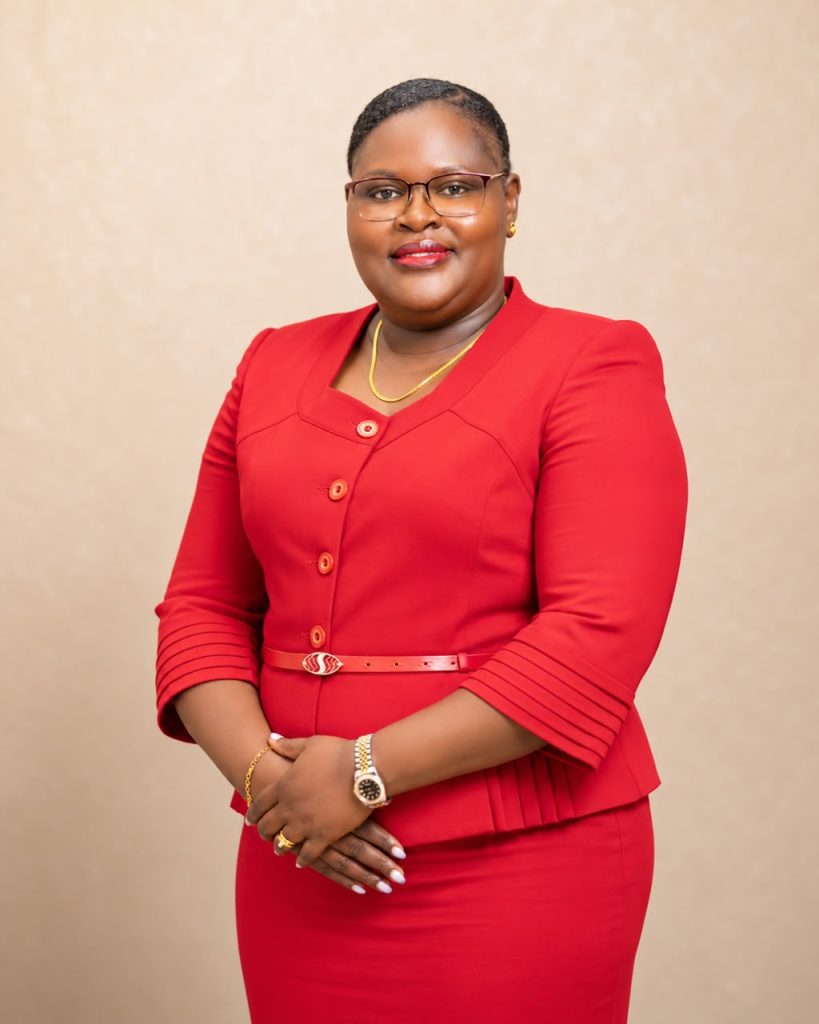
Hilda Martha Aguti is Head of Beer Category at Uganda Breweries Limited (UBL), where she leads strategy and execution for a portfolio that includes some of the most recognizable names on the Ugandan shelf.
Her mandate, in plain terms, is to build brand equity, unlock consumer relevance and turn both into sustainable commercial growth, working across functions rather than from the safety of a single department.
Getting there took her through a deliberately varied route. In a little over eight years she has worked across multinational organizations including Diageo, Unilever, Absa/Barclays, Ecobank, UBA and AAR Healthcare.
That spread, which covers banking, healthcare and fast-moving consumer goods, matters. It means she has sold trust, sold wellbeing and sold dinner, and she will tell you the underlying discipline is the same each time: understand people first, and the rest follows.
Her strengths sit where strategic thinking meets execution. Brand strategy, integrated campaigns, customer and channel development, strategic partnerships, communications, experiential marketing and innovation all show up on her list, but the common skill is translation: taking consumer and market insight and turning it into brand experiences that are felt, and campaigns that move numbers.
The academic foundation is solid and international. She holds an MSc in International Marketing and Strategic Brand Management from Kingston University London and a BA in Mass Communication from Uganda Christian University, and she has gone further still to earn the Chartered Marketer Level 7 certification from the Chartered Institute of Marketing (CIM).
But résumés only tell you where someone has been. The interview that follows tells you how she thinks.
The Interview
What initially sparked your interest in pursuing a career in marketing, and how has that motivation evolved over time?
Like many aspiring marketers, I was fascinated by the influence of great brands. Growing up, I watched brands such as Coca-Cola, Nike, Blackberry and Apple become more than products; they became part of conversations, culture and identity.
I found myself wondering what made them so memorable and how they built such powerful connections with people.
Marketing also appealed to me because of its dynamic nature.
It sits at the intersection of creativity, culture, analytics and business. The variety, pace and constant evolution of the profession meant there was always something new to learn, build or solve.
Over time, I realized that at its core, marketing is the study of people. Understanding what drives behavior, earns trust and shapes decisions became far more fascinating to me than the campaigns themselves.
As my career progressed across banking, healthcare and FMCG, my perspective evolved further.
I came to see marketing not simply as a communications function, but as a strategic driver of growth and business transformation.
Today, I am most motivated by building brands that create genuine meaning in people’s lives. Because when people choose to carry a brand forward in their conversations, routines and memories, business growth naturally follows.
Marketing may begin with brands, but its true power lies in understanding people.
Looking back, which key achievements best illustrate the influence you’ve had on the industry?
One of the defining moments in my career was leading the #WeLoveAfricanacity campaign during the transition from Barclays to Absa in Uganda.
This was not just a campaign; it was a full-scale brand transformation and one of the largest corporate identity transitions on the African continent.
We were moving from the iconic Barclays blue, a color synonymous with heritage, stability and global banking, to Absa’s bold and captivating red, representing a new era of African pride, ambition and possibility.
The challenge was not simply changing how the brand looked but reshaping what it meant to consumers.
A key challenge was managing a delicate balance. We needed to retain our existing affluent customer base, who valued the heritage and stability of Barclays, while simultaneously repositioning the brand to attract a younger, rising professional segment.
This required a very intentional shift in tone and cultural relevance without alienating loyalists. The strength of the campaign lay in achieving both: maintaining trust with our core customer base while successfully recruiting a new generation who saw themselves reflected in the new brand. That dual delivery is what made the rebrand particularly powerful.
The complexity was also in the scale. Every touchpoint changed, from branches and signage to advertising, events, digital platforms, stationery … you name it.
Our role was not simply to communicate a name change, but to rebuild meaning, inspire confidence and create emotional ownership among consumers.
The Africanacity rebrand remains one of my proudest career moments, simply because of the scale, the pressure and the responsibility involved. Rebranding a bank across an entire country means you do not get a second chance. Every detail matters.
Being part of the team that delivered that transformation successfully is something I will always be proud of.
Achieving over 90 percent top-of-mind awareness within a year was a significant business outcome. However, the real impact was cultural.
Seeing consumers adopt the word Africanacity, use it in everyday language, and attach it to moments of pride demonstrated that the brand had moved beyond communication and become part of culture.
For me, that remains one of the most rewarding measures of success: when a brand stops being something people see and becomes something they genuinely believe in because it has created meaning.
A lesson I have carried throughout my career: meaningful brands do not just win attention, they earn belief, and belief is what endures.
Could you share a campaign that made you personally proud?
The Royco relaunch, particularly the Kameza campaign, is one of the projects that fundamentally shaped how I approach marketing.
What made it stand out was a deliberate shift away from generic storytelling towards deep local insight.
We built the campaign around real cooking culture: how families prepare meals, the pride associated with feeding loved ones, the conversations that happen around food, and the everyday realities of household life. It felt authentic because it was rooted in lived experiences rather than assumptions.
The campaign centered on the concept of Kameza, a term that is deeply familiar across many East African households.
While the expression can mean different things to different people, it broadly speaks to the daily economics of running a home and the shared responsibility of providing for a family. By tapping into a cultural truth that consumers immediately recognized, the campaign sparked conversation and engagement at scale.
What made the experience particularly valuable was that it reinforced an important lesson: cultural relevance often requires marketers to embrace complexity.
The most effective campaigns do not simply import global narratives or rely on universal assumptions. They take the time to understand the local context, the nuances and the realities that shape consumer behavior.
The impact was immediate because consumers saw themselves in the work.
It looked like them, sounded like them and respected their reality. That is when engagement moves beyond attention and becomes genuine connection.
At the same time, working within a global organization reinforced the importance of balancing local expression with global principles. The most impactful work sits at that intersection: globally aligned, yet deeply locally relevant.
That experience taught me that cultural relevance is not a nice to have; it is a growth driver.
Because when people feel understood, conversations happen. When conversations happen, trust grows. And when trust grows, brands earn the right to become part of culture.
For marketers, the lesson is simple: consumers do not connect with what is universally correct; they connect with what feels genuinely true to their lived experience.
Marketing is constantly evolving. What transformations have you made to stay ahead?
To stay ahead, I have made a deliberate commitment to continuous learning, staying curious and surrounding myself with people who challenge my thinking.
One of the most practical things I do is spend time understanding younger audiences.
I engage with my nieces, nephews and their friends because they provide an unfiltered view of how consumer behavior is evolving. What they pay attention to, what they ignore, how they consume content and how they make decisions often provides early signals of where culture is heading.
I have also evolved how I approach marketing itself. Early in my career, the focus was often on delivering great campaigns.
Today, my focus is on building brands and ideas that can sustain relevance over time, grounded in consumer insight, data and a clear understanding of the role a brand plays in people’s lives.
Technology has also transformed the profession. Marketers today have access to more data, tools and consumer feedback than ever before. The challenge is no longer access to information; it is knowing how to translate that information into meaningful action.
At a leadership level, my transformation has been from doing to enabling.
Building strong teams, creating clarity, fostering diverse perspectives and empowering others to do their best work has become just as important as delivering results myself.
Ultimately, I have learned that staying ahead is less about predicting the future and more about remaining open to learning from it.
Marketing does not reward experience alone; it rewards those who are willing to keep evolving long after they become experts.
Which leadership principles guide your approach?
I’ve been fortunate to work with highly driven teams, people who do not need to be pushed to deliver. In those environments, leadership becomes less about control and more about alignment.
Once the objective, expectations and standards are clear, my role is to keep the team focused and remove obstacles.
Because clarity drives ownership, and ownership drives performance.
That said, not every team starts there. Some situations require a more hands-on approach: being present, guiding more closely and building confidence until people are ready to take full ownership. I am comfortable flexing my style to meet the needs of the team and the moment.
At my core, I operate with a hands-off but always available approach.
I trust my team to execute, but they know I am there for guidance, support or a second opinion when needed.
I have found that when teams feel trusted, they step up. And often, they exceed expectations.
What challenges shaped your career most?
One of the most defining challenges in my career has been transitioning from a technical marketing role into a leadership role.
Earlier in my career, success was tied to personal delivery: how well I could execute and how strong the work was. Stepping into leadership required a fundamental shift in mindset.
I had to move from doing to enabling, building capability in my team, creating clarity and trusting others to deliver.
The real shift was understanding that my impact is no longer defined by what I do, but by what my team achieves. As long as you are leading people, you are always learning.
Every team brings different personalities, motivations and perspectives, and the role of a leader is to harness that diversity and create an environment where people can perform at their best.
Another challenge has been navigating the tension between global brand guardrails and local relevance.
Especially in African markets, authenticity matters deeply, yet consistency across markets remains critical. Operating at that intersection taught me that the most impactful work is globally aligned but deeply locally relevant.
Along the way, I have also learned that speed matters just as much as quality. In today’s environment, speed is not a trade-off; it is a competitive advantage.
I have shifted from focusing solely on creative excellence to driving commercial impact, because great marketing is ultimately measured by the value it creates for both consumers and the business.
Perhaps the most enduring lesson has been the importance of staying grounded in real consumer insight. Consumers do not experience brands through strategies, frameworks or presentations.
They respond to what feels relevant, authentic and true in their everyday lives.
All of these experiences have pushed me to evolve, not just as a marketer, but as a leader.
They have taught me that brand building is a long game, leadership is a continuous learning journey, and lasting impact comes from empowering others while remaining relentlessly focused on the consumer.
Growth, for me, has never come from having all the answers.
It has come from staying curious enough to keep learning and confident enough to keep evolving.
If you weren’t in marketing, what would you be doing?
Definitely something creative. Possibly interior design, fashion, event hosting or art. Unfortunately, there were two obstacles standing in the way of music: my father was never going to fund that dream, and God did not provide the singing voice to justify it.
At the core, I enjoy creating experiences. Whether it is designing a space, curating an event or building a campaign, I am drawn to the process of bringing ideas to life and seeing how people respond to them.
That is probably why I found my way into marketing.
It brings all of those elements together: creativity, attention to detail, emotion and connection, in a way that also drives real impact.
So in many ways, I did not choose one path over the other; marketing simply became the most complete expression of all of them.
Looking back, I think the profession was never really the point. Creating things that people connect with was.
What advice would you give to professionals in marketing today?
Stay curious. Stay humble. Stay hungry.
Marketing is evolving faster than ever, and the professionals who thrive are those who remain committed to learning, listening and adapting. Trends will change, technology will evolve and platforms will come and go, but a deep understanding of people will always remain the foundation of great marketing.
You need to be comfortable with data, but never lose sight of the human behind the numbers.
You need to think strategically, but also appreciate that ideas only create value when they are executed brilliantly.
I would also encourage marketers to spend less time chasing what is new and more time understanding what is true. Consumer behavior evolves, but the fundamentals of trust, relevance, emotion and connection remain remarkably consistent.
Most importantly, do not lose your sense of curiosity and excitement for the craft.
The best marketers I know are still fascinated by consumers, still inspired by great work and still eager to learn from others regardless of where they are in their careers.
Marketing rewards those who stay close to people, because while technology changes, human nature rarely does.
What legacy do you hope to leave, and how do you see the future of your work?
Having worked across both global and local brands, from Unilever with Royco, Omo and Sunlight, to Uganda Breweries with Uganda Waragi, Bond 7 and V&A, I want to be remembered as a brand builder who helped scale African brands into globally competitive powerhouses.
My aspiration is to build campaigns, platforms and experiences that do more than drive short-term results.
I want to contribute to building enduring brand equity and positioning African brands to compete confidently on the global stage.
We are operating in a truly connected world today, and the opportunity is significant. Across industries, we are seeing African businesses, creators and innovators demonstrating what is possible when local insight is combined with ambition and excellence.
Swangz Avenue is shaping mainstream sound and talent across East Africa.
ATS delivers world-class production and experiential execution that rivals global standards.
Vacker is redefining OOH visibility through bold, attention-commanding formats. Denim Kartel is building a fashion movement rooted in African identity and designed for global relevance.
Belazuri is building beauty rooted in African identity. Ezi with Creativity is redefining digital artistry through mosaic and vector art that blends technical precision with authentic African storytelling.
Artists such as Joshua Baraka are proving that local talent can resonate far beyond our borders. Entertainers such as Etania are showing what becomes possible when talent is paired with authenticity, consistency and ambition.
Through her groundbreaking Etania: Becoming Life of the Party concert, which Smirnoff proudly sponsored, she challenged traditional perceptions of what a DJ could be and inspired an entire ecosystem of creators, entertainers and brands.
To me, that is how talent scales and how culture is exported. These are just a few examples among many others emerging across the continent that demonstrate the incredible potential of African brands, talent and creativity on the global stage.
For me, building brands that can compete globally comes down to three things: grounding everything in authentic local insight, executing with world-class standards, and building platforms rather than one-off campaigns. The brands that win will be those that remain culturally authentic while being globally relevant.
That is the role I see myself playing: bridging local truth with global ambition and helping build brands that can compete anywhere in the world.
My legacy will not be measured by the campaigns I launched, but by the brands I helped make globally undeniable.
The Takeaway
The conclusion argues that everything Hilda said comes back to one idea: people fall for what feels true, not for strategies.
Africanacity and Kameza worked because they were recognitions, not imports. It calls her advice to chase what is true over what is new easy to nod along to and hard to practice. It singles out her shift from doing to enabling as probably the most useful line for younger marketers.
It ends on her ambition to be remembered for brands made “globally undeniable,” a bet it says is unwise to go against.
It then teases the next episode and leaves readers with a question: when people use your brand’s language in their own, have you built something they believe in, or just something they have seen her.
Next in People Behind Brands, we meet another marketer shaping what East African brands become. Until then, a question worth carrying out of this conversation: when people use your brand’s language in their own, have you built something they believe in, or just something they have seen?
People Behind Brands is a segment of Evolve Africa, profiling the marketers, young and old, who shape the brands East Africa lives with.