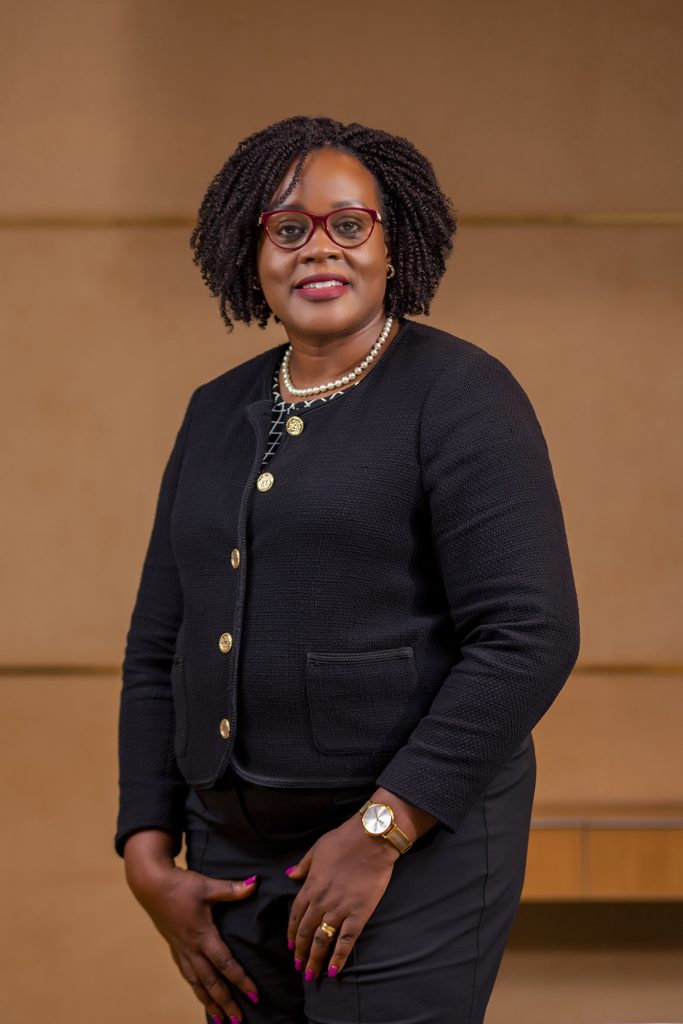
EXECUTIVE OF THE WEEK: AMOS WEKESA
- 12:17 pm
There is an office in Kampala, not far from the one Amos Wekesa now occupies, that no longer exists. A cramped nook tucked beneath a staircase, rented in 2001 for a business that consisted, at the time, of two hundred American dollars, a borrowed phone line, and a man who had spent the previous four years earning a dollar a day as a tour guide. It is tempting, in profiles like this one, to treat the origin story as decoration, a colourful preamble before the “real” business talk begins.
With Wekesa, the staircase office is the business talk. Everything Great Lakes Safaris has become since a conglomerate of lodges, camps, a marine transport venture, an agro-processing company, and a foundation, employing well over 250 people and generating revenues in the region of eight million dollars a year, traces back to a man who did not go to school until he was ten years old, and only then because the Salvation Army happened to be recruiting two boys from his village in Lwakhakha.
That detail matters more than it might first appear. Uganda’s tourism sector, for much of its modern history, has been an industry built by outsiders, foreign-owned lodges, foreign tour operators, foreign capital moving through a landscape that was never foreign at all. Wekesa has spent two decades quietly complicating that picture.
He is, by his own account and by the account of nearly everyone who has written about him, one of a small number of indigenous Ugandan entrepreneurs to build a safari business of real scale from nothing,not inherited, not franchised, not backed at the outset by anyone but himself.
The early years were unglamorous in the way that founding stories rarely are once they’ve been polished for retelling. Before Great Lakes Safaris, there was a stint as a sweeper earning ten dollars a month, then a slightly better-paid post as an office messenger. Wekesa has spoken about those jobs without embarrassment, treating them less as humiliations to be overcome than as the tuition he paid before starting his own company. By the time he set up on his own, he already understood the tour operating business from the ground up,literally, in the case of the ground he’d covered as a guide, and structurally, in the case of the industry he’d go on to reshape.
Great Lakes Safaris marked its twentieth anniversary in 2021, a milestone that arrived, inconveniently, in the middle of a pandemic that had gutted global tourism and, with it, a large share of Wekesa’s income.
Rather than retreat, he diversified into Uganda Lodges, into a water-transport venture on Lake Victoria, and, more surprisingly, into agro-processing through Pela Commodities, a grain business he co-founded in Soroti with three partners. It was not an obvious pivot for a safari operator, and it says something about Wekesa’s instincts that he treated a crisis in one industry as licence to build resilience in an entirely different one, rather than simply waiting for tourists to return.
Wekesa’s influence has never stayed confined to his own balance sheet. He has served as President of the Uganda Tourism Association, sat on the Uganda Tourism Board, and chaired the tourism working group of the Presidential Investment Round Table, the kind of institutional positions that tend to go to people the industry trusts to speak for it, not just about it. He also founded the Rwenzori Marathon and, later, the Great Lakes Safaris Foundation, a give-back initiative aimed at communities living near Uganda’s more vulnerable wildlife areas — a natural enough extension for a businessman whose own path out of poverty was made possible by someone else’s willingness to invest in a stranger’s child.
That instinct for turning a single idea into an entire regional economy is on full display this week. On Saturday, the Tusker Lite Mt Rwenzori Marathon returns to Kasese for its fifth edition, and Wekesa ,who co-founded the race in 2022 with former Vision Group CEO Robert Kabushenga, and now serves as its team lead has spent the run-up doing what he has always done best: turning a sporting event into a tourism argument.
More than four thousand entries had been registered as of this week, over two thousand race kits already collected, and a delegation of international runners and running influencers, most of them from South Africa, was welcomed into Kampala on Monday before heading west toward the Rwenzoris with a film crew in tow.
Government has leaned in accordingly,the National Council of Sports alone has put some 3.7 billion shillings behind the event, largely to swell the prize purse, while Uganda Development Bank added a further 20 million shillings this month specifically to strengthen the marathon’s economic footprint in Kasese.
Last year’s edition pulled 18,000 visitors from 36 countries; organisers are chasing a field drawn from nearly 45 this time round. Asked, back when the race was still new, what charity the marathon was really in aid of, Wekesa gave the kind of answer that could serve as his professional epitaph: it isn’t charity at all, he said,it’s a business that brings business to Kasese, one hotel booking and one hired guide at a time.
What comes through, across the interviews Wekesa has given over the years, is a conviction — bordering on evangelism about Uganda’s tourism potential specifically, not East Africa’s generally. He argues that Uganda’s inland waterways give it a variety no single Serengeti game drive can match: a boat trip, a forest walk, and a game drive inside the same national park, in the same day.
It’s a pitch he’s been making for two decades, to conference audiences and journalists alike, and the fact that he’s still making it, still positioning Uganda as underrated rather than arrived suggests a man who sees his work as unfinished, not because the business has stalled, but because the country’s story hasn’t yet caught up to what he believes it deserves.
Twenty-five years on from the staircase office, Wekesa’s name sits comfortably alongside Uganda’s most recognisable entrepreneurial success stories.
What distinguishes him within that company is less the scale of what he built than the honesty with which he still describes how he built it as luck, as grit, and as a debt to people who once bet on a ten-year-old boy from a border village they had no reason to notice